


How to choose your MTB frame?
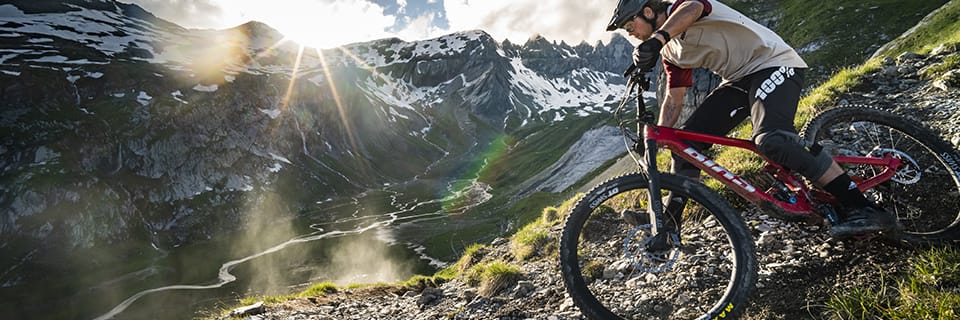
Decisive for the handling and comfort of your bike, choosing an MTB frame requires taking several factors into consideration. Here are the keys to choosing it with full confidence.
Standards
Before choosing your frame, make sure you clearly identify its various characteristics so as not to encounter compatibility issues with other components:
- Wheel size
- Headset type
- Bottom bracket type
- Wheel axle type
- Front derailleur type
- ISCG type for setups with a chain guide
Materials
-
Steel
A steel frame offers great flexibility and unmatched strength at an affordable price. Its greater elasticity compared to other metallic materials makes it physically accessible to all cyclists. Competitive riders will criticise its excessive weight and lack of stiffness, even though it is now possible to find high-end steel frames almost as stiff and lightweight as aluminium frames.
-
Aluminium
Just like steel, aluminium frames have evolved considerably. Once reputed to be very stiff and uncomfortable, frames made from this alloy have made great progress thanks to thinner tube walls, also offering a weight saving.
Two types of aluminium are mainly used: 6061 and 7005, the former being considered lighter while the latter is stronger. Some manufacturers also offer scandium frames. Combined with aluminium, it allows a weight saving of 10 to 15%.
-
Carbon
Found on high-end frames due to its cost, carbon is the material of choice in modern cycling. Able to be combined endlessly with other fibres, carbon produces frames that are certainly high-performing, lightweight and stiff, but demanding both physically and technically. Carbon is therefore primarily intended for competitive riders.
-
Titanium
Finally, a few rare frames are made from titanium. The ultimate benchmark in terms of weight-to-comfort-to-efficiency ratio, and therefore ideal for Cross-Country riding, titanium nonetheless remains very expensive.
Which frame for my riding style?
Manufacturers carefully select each material to offer the best balance between performance, weight, strength and price for each discipline.
-
Touring
For a touring-oriented ride, the ideal is above all a comfortable and reliable frame, as found on our leisure MTBs. A steel or aluminium hardtail is recommended to maintain good efficiency. Some will prefer a full-suspension MTB for more comfort, preferably in 27.5" or 29", and designed for a fork with 100 to 130 mm of travel to increase versatility.
-
Cross-Country
For Cross-Country rides, a hardtail frame in aluminium or, more exclusively, in carbon, for maximum responsiveness. Wheels preferably in 29" and a fork between 80 and 120 mm to be as fast as possible on the rolling sections as well as in technical terrain.
-
All-Mountain
For All-Mountain riding, we recommend an MTB capable of both climbing very well and being comfortable on descents, even aggressive ones. So, look for a full-suspension bike with 130 to 150 mm of travel. The recreational rider will go for an aluminium frame with 27.5" or 29" wheels, while the competitive rider will be tempted by carbon in 27.5" or 29" depending on their height and whether they prioritise handling precision and responsiveness or obstacle-clearing ability.
-
Enduro
When it comes to Enduro, the frame does not necessarily need to be the highest-performing for climbing — it is above all on descents that it will come into its own. A full-suspension bike is the way to go. The recreational rider will go for an aluminium frame with 27.5" or 29" wheels, while the competitive rider will be tempted by carbon in 27.5" or 29" depending on their height and whether they prioritise handling precision and responsiveness or obstacle-clearing ability. As for travel, the minimum will be 140 mm, with the more adventurous riders going up to 180 mm.
-
DH/Freeride
If you ride DH/Freeride, a full-suspension aluminium bike is a must, even if carbon is becoming increasingly widespread in this discipline too for those chasing seconds at the finish line. With 200 mm of travel to absorb everything and wheels in 27.5" for maximum reactivity or 29" for maximum handling ease.
Découvrez tous nos conseils & Tutoriels


